Written by Rev Melinda McMahon, National Director
Earlier this year, shortly before finishing up at Southlakes, I had the privilege of joining Graeme and Susan Liersch at the SOMA National Directors’ Forum — a gathering that happens only once every four years or so, bringing together SOMA leaders from around the world for prayer and strategic direction.
It was a remarkable space to be part of. Alongside our own team from Australia, we gathered with Andrew Allan-Johns (SOMA New Zealand), Richard Moy (SOMA UK), Kyle Spradley (SOMA USA), Henry Blair (SOMA Northern Ireland), Tom Otieno (SOMA Kenya) and Buli Wooley (SOMA South Africa). We were also joined by James and Beatrice Jarinda from Uganda, invited to learn how to establish a SOMA office in their nation — the very partnership you’ve read about elsewhere in this newsletter. Also attending was Jonas B, a missional entrepreneur exploring the possibility of establishing a SOMA presence in Sweden. We were honoured also to have Archbishop Abraham from Northern India and Bishop Nason from Uganda with us. It was a genuine picture of what SOMA has become — a growing, global family of ministries, each learning from and strengthening the others.
Alpha Leadership Conference. Our first days together were spent at the Alpha Leadership Conference in London — a gathering of around 5,000 to 6,000 Christians from almost every denomination and background imaginable. What struck me most wasn’t just the size of the crowd, but its age: roughly 90% were young people. The atmosphere was electric — passionate worship, a deep hunger for God, and a sense that people weren’t merely interested in ideas about God, but genuinely expectant that he would move. It is unusual to be part of a gathering that unites the Church so completely, and I found it deeply inspiring. Among the afternoon workshops on offer, I chose Prayer in the Life of the Christian Leader and Developing a Rhythm in the Age of Technology — both of which gave me things I’m still applying in my own life and ministry.
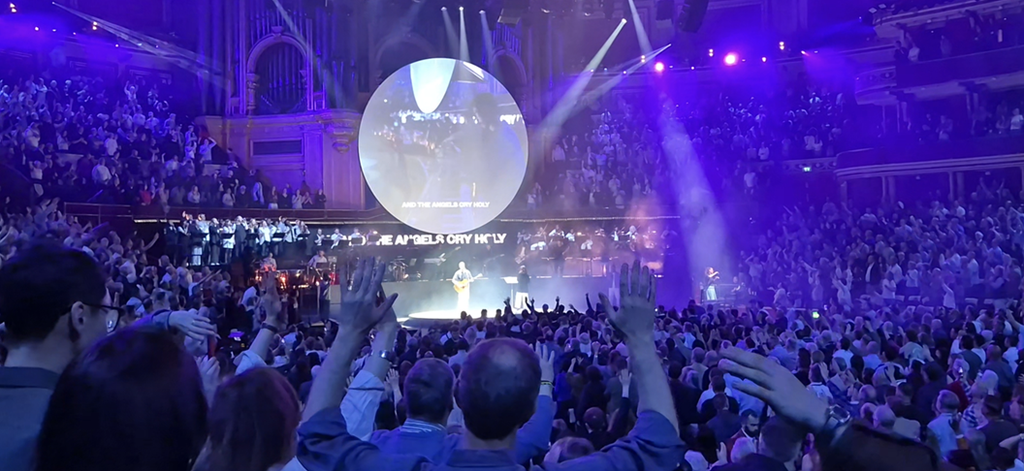
Listening to testimony after testimony from young people who had been invited to explore faith and had gone on to give their lives to Jesus, I found myself quietly convicted. I began asking: Lord, am I really giving your Spirit room to move when I share my faith with the people around me?
From London, the team flew on to Northern Ireland, where we were hosted with wonderful generosity by Dean Henry’s congregations. Many of us had the opportunity to preach in various churches, and Graeme and Susan were able to reconnect with communities they had first met more than three years earlier.
Our first day in Northern Ireland was devoted to prayer. The next day we separated with the National Directors seeking God’s direction for how the international SOMA body should function and be organised going forward. At the same time, the Chairs of SOMA New Zealand, Australia, and the UK were meeting, wrestling with questions of governance and the much-needed update to the SOMA Constitution. When the two groups came back together to debrief, there was a genuinely surprising level of agreement — both groups resolving independently to work together in a far more cohesive way in the future. It felt like a real gift from God, and a hopeful sign for SOMA’s international future.
An unexpected reunion. One evening, we were invited to an Evangelical Encouragement Dinner for the Diocese of Down and Dromore. Those of us who had been part of the SOMA International mission there three years earlier wondered whether we’d recognise any familiar faces. We did — and it was a joy to hear how that earlier mission had brought lasting refreshing and empowering to several parishes. But one family in that room stood out above all else.
Three years ago, on that earlier mission, I had knelt with a team of four others in front of a young man — around 17 years old, seated in a wheelchair, his body weakening from severe muscle atrophy, living with constant pain. As we spoke with him about the power of the Holy Spirit, something stirred in him, and he asked simply, “Would you pray for me?” So we did. We prayed in faith for his healing. And nothing happened — at least, nothing we could see. Those were honestly difficult, silent moments. All we could offer him was this: “Keep trusting that God is at work, even when you can’t see it.”
Three years later, at that same Encouragement Dinner, that same young man was there. Only this time, he was standing. Walking. Free from pain. And beginning to dream again — about a future as a sports journalist.
That is the kind of story that stops you and makes you ask: am I living with expectancy of the Spirit’s presence and power everywhere I go?
Reflecting on Pentecost power. During our time together, the National Directors reflected again on our shared calling — to tend to “the nervous system of the body of Christ.” It’s a curious phrase, but a powerful one. A nervous system is what carries signal through a body; it enables movement, responsiveness, connection. Without it, a body may exist, but it cannot function as it should. That is exactly the role of the Holy Spirit within the Church — connecting us, animating us, directing us, bringing life and responsiveness to the body of Christ. And what became clear, listening to leaders from every corner of the globe, is that the Church everywhere is hungry — not primarily for better structures or clearer strategy, but for the living power of the Holy Spirit.
Acts 4 shows us what that power looks like in practice. Facing threats to stop speaking about Jesus, the early disciples didn’t pray for safety. They prayed:“Enable your servants to speak your word with great boldness. Stretch out your hand to heal and perform signs and wonders through the name of your holy servant Jesus.” They understood something we can easily forget — that a supernatural gospel requires supernatural power to adequately represent it. As Paul later wrote of his own ministry, “My message and my preaching were not with wise and persuasive words, but with a demonstration of the Spirit’s power… so you would trust not in human wisdom but in the power of God” (1 Cor 2:4-5).
That young man in Northern Ireland is proof that this demonstration doesn’t always come in the moment we ask for it. Sometimes God’s healing power is immediate. Sometimes it unfolds over years. But it is real, it is active, and — as we saw with our own eyes — it is still at work today.
So this is what I bring back from London and Northern Ireland, and what I want to leave with you: we are invited to expect power — the Holy Spirit has not changed, and God is no less active today than in the book of Acts. We are invited to pray boldly — not small, safe prayers, but prayers that ask God to stretch out his hand. And we are invited to witness confidently — because the message we carry is not a philosophy or a memory of things long past, but news of a living, active God who is still at work through his Spirit-filled people.
We are part of that nervous system — ordinary people through whom the life and power of the Spirit flows into the world. So let’s make the prayer of the early Church our own:
“Lord, enable your servants to speak your word with great boldness. Stretch out your hand to heal and perform signs and wonders through the name of your holy servant Jesus.”
Come, Holy Spirit. Fill us again. Empower us again — that we might be your witnesses, in word and in power. Amen.