SOMA eNewsletter September 2026 – Out Now!

Greetings to all friends of SOMA,

It has been over a year since you last heard from us — and for that, I want to begin simply by saying thank you. Thank you for your patience, your continued prayer, and your faithful partnership with SOMA even during a season when our newsletter went quiet. That silence had a very ordinary cause: I relocated from Southlakes Anglican Church in the Diocese of Newcastle, NSW where I served as Rector for six years, to take up the role of Vicar at St Matthew’s Anglican Church in Endeavour Hills, in the Diocese of Melbourne, VIC. Relocation — as many of you know from your own experience — has a way of consuming every spare hour. But SOMA has not stopped, our missioners have not stopped, and neither has the Lord of the Harvest. I’m delighted to be back in touch.

I want to share with you where this newsletter’s theme comes from, because it has followed me — almost providentially — from one diocese to another.

On my final Sunday at Southlakes, I preached a message titled “The Harvest is Plentiful,” drawn from Matthew 9:35–10:8. It was written on the back of two weeks on mission in Northern Ireland, where I’d also attended the Alpha Leadership Conference in London. That message asked a simple question: when you picture your street, your neighbours, your workmates — what do you assume about their openness to God? So often, without realising it, we assume the harvest around us is thin. We assume people aren’t interested, that faith is private, that someone else will get to it eventually.

But that isn’t what Jesus saw. Matthew tells us Jesus moved through the towns and villages — present, close, listening — and “when he saw the crowds, he had compassion on them, because they were harassed and helpless, like sheep without a shepherd” (Matt 9:36). Not indifferent. Not closed. Harassed and helpless — spiritually exhausted and searching, whether they’d name it that way or not. And so, Jesus says the words that have shaped this newsletter’s title: “The harvest is plentiful, but the workers are few” (v.37).
Three assumptions quietly hold us back from that harvest: that the people around us aren’t really hungry; that we’re not qualified to be workers; and that someone else – the minister, the more “spiritual” one will get to it instead. Jesus answers all three. He chose fishermen, a tax collector, and a political radical as his first workers, and only then gave them authority (10:1). The calling always comes before the equipping. And the sending is urgent — the same word used elsewhere for casting out demons.  This is not a gentle suggestion. It is everyone’s calling, starting now, with what we already carry: “Freely you have received; freely give” (10:8)

Here is why I share all this with you now. On my second week in the Diocese of Melbourne, I attended the Diocese Clergy Conference and heard Archbishop Ric Thorpe preach a message that felt almost identical to the one I had preached weeks earlier at Southlakes. He introduced the diocese’s new strategic vision — For the Harvest — calling every disciple, leader, church and ministry to take its next faithful step for the sake of the harvest God has already prepared. On the final night, we gathered in the Cathedral for the most participative prayer meeting I have ever experienced — prayer stations around the perimeter, vibrant contemporary worship, and even a firepit where we could light our written prayers. It marked, unmistakably, the beginning of a new season for the diocese.

We prayed this prayer together, and I want to share it with you:

Lord of the Harvest,
The harvest belongs to God. The Church belongs to God.
The Spirit gives life. We are called to pray and to act.
Confident in Christ, we are called for the harvest:
to pray for workers, to grow as disciples,
to raise up leaders, to renew the Church,
so that every disciple, leader, church and ministry may take its next faithful step for the glory of God and the benefit of the communities we serve.

Perhaps this could be SOMA’s prayer too — but I want to add something to it, because of who we are. SOMA exists to care for the nervous system of the body of Christ through the ministry of the Holy Spirit. And if the harvest is truly plentiful, then it is not enough for us simply to notice it, or even to pray for workers in general terms. As missioners who have seen firsthand what happens when ordinary Anglicans step into the power of the Spirit — when the sick are prayed for, when prophetic words bring clarity, when the Spirit moves in evangelism as naturally as in worship — we carry a particular responsibility. We cannot proclaim the good news of the kingdom while leaving behind the works that accompanied it in Matthew 9:35: teaching, proclaiming, and healing every disease and sickness. The gospel Jesus modelled was never word alone. It was word and Spirit, together, wherever people were harassed and helpless.

So as we relaunch this newsletter, that is our renewed conviction: the harvest is plentiful, the Spirit is present and willing, and SOMA’s calling is to equip and send workers who will not shy away from ministering in the Spirit’s power as they share the good news of Jesus — whether in Endeavour Hills, in Melbourne, or anywhere else in Australia or on the mission fields you’ll read about in this newsletter.

One further note before I close this greeting. Many of you will have noticed that we did not hold an Anglicans Ablaze Conference this year. Between the transition to St Matthew’s and the many demands of this season, we discerned it was wiser to pause and revisit the conference in 2027 rather than run it without the capacity to do it well. I would ask you to continue holding this in prayer — for wisdom in timing, for the right team to gather around it, and for the conference, when it returns, to be a genuine catalyst for renewal across our churches.

Thank you, as ever, for standing with SOMA in prayer and support. Read on to hear about two mission opportunities the Lord has placed before us this coming season — one already underway with the Diocese of Central Melanesia, and one new invitation from soon-to-be-birthed SOMA Uganda.

The harvest is plentiful. Let’s go together.

Yours in Christ’s service Rev Mel
Gathering of the Nations: SOMA National Director’s meet in London and Northern Ireland

Written by Rev Melinda McMahon, National Director

Earlier this year, shortly before finishing up at Southlakes, I had the privilege of joining Graeme and Susan Liersch at the SOMA National Directors’ Forum — a gathering that happens only once every four years or so, bringing together SOMA leaders from around the world for prayer and strategic direction.

It was a remarkable space to be part of. Alongside our own team from Australia, we gathered with Andrew Allan-Johns (SOMA New Zealand), Richard Moy (SOMA UK), Kyle Spradley (SOMA USA), Henry Blair (SOMA Northern Ireland), Tom Otieno (SOMA Kenya) and Buli Wooley (SOMA South Africa). We were also joined by James and Beatrice Jarinda from Uganda, invited to learn how to establish a SOMA office in their nation — the very partnership you’ve read about elsewhere in this newsletter. Also attending was Jonas B, a missional entrepreneur exploring the possibility of establishing a SOMA presence in Sweden. We were honoured also to have Archbishop Abraham from Northern India and Bishop Nason from Uganda with us. It was a genuine picture of what SOMA has become — a growing, global family of ministries, each learning from and strengthening the others.

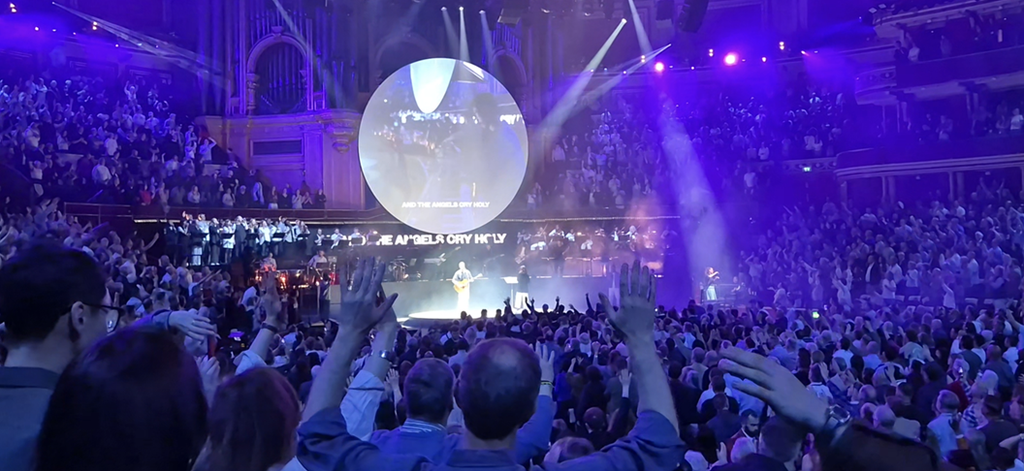
Alpha Leadership Conference. Our first days together were spent at the Alpha Leadership Conference in London — a gathering of around 5,000 to 6,000 Christians from almost every denomination and background imaginable. What struck me most wasn’t just the size of the crowd, but its age: roughly 90% were young people. The atmosphere was electric — passionate worship, a deep hunger for God, and a sense that people weren’t merely interested in ideas about God, but genuinely expectant that he would move. It is unusual to be part of a gathering that unites the Church so completely, and I found it deeply inspiring. Among the afternoon workshops on offer, I chose Prayer in the Life of the Christian Leader and Developing a Rhythm in the Age of Technology — both of which gave me things I’m still applying in my own life and ministry.

Listening to testimony after testimony from young people who had been invited to explore faith and had gone on to give their lives to Jesus, I found myself quietly convicted. I began asking: Lord, am I really giving your Spirit room to move when I share my faith with the people around me?

From London, the team flew on to Northern Ireland, where we were hosted with wonderful generosity by Dean Henry’s congregations. Many of us had the opportunity to preach in various churches, and Graeme and Susan were able to reconnect with communities they had first met more than three years earlier.

Our first day in Northern Ireland was devoted to prayer.  The next day we separated with the National Directors seeking God’s direction for how the international SOMA body should function and be organised going forward. At the same time, the Chairs of SOMA New Zealand, Australia, and the UK were meeting, wrestling with questions of governance and the much-needed update to the SOMA Constitution. When the two groups came back together to debrief, there was a genuinely surprising level of agreement — both groups resolving independently to work together in a far more cohesive way in the future. It felt like a real gift from God, and a hopeful sign for SOMA’s international future.

An unexpected reunion. One evening, we were invited to an Evangelical Encouragement Dinner for the Diocese of Down and Dromore. Those of us who had been part of the SOMA International mission there three years earlier wondered whether we’d recognise any familiar faces. We did — and it was a joy to hear how that earlier mission had brought lasting refreshing and empowering to several parishes. But one family in that room stood out above all else.

Three years ago, on that earlier mission, I had knelt with a team of four others in front of a young man — around 17 years old, seated in a wheelchair, his body weakening from severe muscle atrophy, living with constant pain. As we spoke with him about the power of the Holy Spirit, something stirred in him, and he asked simply, “Would you pray for me?” So we did. We prayed in faith for his healing. And nothing happened — at least, nothing we could see. Those were honestly difficult, silent moments. All we could offer him was this: “Keep trusting that God is at work, even when you can’t see it.”

Three years later, at that same Encouragement Dinner, that same young man was there. Only this time, he was standing. Walking. Free from pain. And beginning to dream again — about a future as a sports journalist.

That is the kind of story that stops you and makes you ask: am I living with expectancy of the Spirit’s presence and power everywhere I go?

Reflecting on Pentecost power. During our time together, the National Directors reflected again on our shared calling — to tend to “the nervous system of the body of Christ.” It’s a curious phrase, but a powerful one. A nervous system is what carries signal through a body; it enables movement, responsiveness, connection. Without it, a body may exist, but it cannot function as it should. That is exactly the role of the Holy Spirit within the Church — connecting us, animating us, directing us, bringing life and responsiveness to the body of Christ. And what became clear, listening to leaders from every corner of the globe, is that the Church everywhere is hungry — not primarily for better structures or clearer strategy, but for the living power of the Holy Spirit.

Acts 4 shows us what that power looks like in practice. Facing threats to stop speaking about Jesus, the early disciples didn’t pray for safety. They prayed:“Enable your servants to speak your word with great boldness. Stretch out your hand to heal and perform signs and wonders through the name of your holy servant Jesus.” They understood something we can easily forget — that a supernatural gospel requires supernatural power to adequately represent it. As Paul later wrote of his own ministry, “My message and my preaching were not with wise and persuasive words, but with a demonstration of the Spirit’s power… so you would trust not in human wisdom but in the power of God” (1 Cor 2:4-5).

That young man in Northern Ireland is proof that this demonstration doesn’t always come in the moment we ask for it. Sometimes God’s healing power is immediate. Sometimes it unfolds over years. But it is real, it is active, and — as we saw with our own eyes — it is still at work today.

So this is what I bring back from London and Northern Ireland, and what I want to leave with you: we are invited to expect power — the Holy Spirit has not changed, and God is no less active today than in the book of Acts. We are invited to pray boldly — not small, safe prayers, but prayers that ask God to stretch out his hand. And we are invited to witness confidently — because the message we carry is not a philosophy or a memory of things long past, but news of a living, active God who is still at work through his Spirit-filled people.

We are part of that nervous system — ordinary people through whom the life and power of the Spirit flows into the world. So let’s make the prayer of the early Church our own:

“Lord, enable your servants to speak your word with great boldness. Stretch out your hand to heal and perform signs and wonders through the name of your holy servant Jesus.”

Come, Holy Spirit. Fill us again. Empower us again — that we might be your witnesses, in word and in power. Amen.

Upcoming mission to Solomon Islands: SOMA US & NZ working together

A Province Equipped: Returning to the Solomon Islands

Last year we reported on SOMA’s mission in Honiara, Solomon Islands where a SOMA Australian team worked alongside the clergy of the Diocese of Central Melanesia — a rich and encouraging time of ministry in the power of the Spirit. We’re now delighted to share the next step in that relationship, and it is a bigger step than anything we’ve previously attempted in the Solomon Islands.

In partnership with SOMA New Zealand, we are planning a Provincial Training Mission — an initiative designed not just to bless one diocese, but to equip the whole Church of Melanesia in the ministry of the Holy Spirit.

Here’s how it will work. The bishop and two selected clergy from each participating diocese will gather at a central location for two full days to receive SOMA’s Core Teaching and ministry workshops, delivered by a team drawn from SOMA Australia and New Zealand. From there, two missioners will travel back with each bishop and their clergy into their own diocese, delivering the same material to leaders, clergy, and laity through a series of two-day and one-day events. Throughout this process, the selected clergy are trained to progressively carry and deliver the teaching themselves — so that what begins with a visiting team ends with a diocese fully equipped to continue teaching and ministering in the Spirit long after we’ve returned home.

This is the heart of SOMA’s calling: we don’t come to do ministry for a diocese — we come to plant something that a diocese can sustain and multiply itself.

The practical details:

  • SOMA Missioners are expected to raise their own airfare and bring an allowance for nominal daily expenses.  We are hoping for local hospitality for the team, however accommodation costs may be incurred.
  • Allowing for travel, we anticipate nine days on the ground for each team.
  • We’re aiming for late June 2027, which gives us time to recruit and prepare enough missioners to cover every participating diocese.

Over the past few years SOMA has developed a simple seven-sheet booklet entitled “SOMA’s Core Teaching on the Holy Spirit” which is designed to be reproduced cheaply on any office photocopier with a built-in stapler, and given freely, without copyright, to every parish and leader who receives it. It has already been used to renew and equip Anglican dioceses widely around the world, and is currently available in six languages. As part of this mission, we would hope to see it translated into Pijin or Bislama, so that it can take root in the heart language of the communities we’re serving.

This is where you come in. A mission of this scale — training an entire province — needs a genuine team: teachers, ministry workers, encouragers, people with a heart for the practical things of the Spirit and a willingness to travel simply and stay humbly. If reading this stirs something in you, we would love to hear from you. Please get in touch to express your interest in being part of this mission, even at this early stage — the sooner we know who might be available, the sooner we can plan well for every diocese involved. Please also hold this mission in prayer over the coming weeks, as decisions are being finalised and dates confirmed. Pray for the bishops and dioceses of the province as they discern their participation, for the international team as it comes together, and for the Core Teaching material itself — that wherever it lands, in whatever language, it would bring genuine renewal in the power of the Holy Spirit.

A new door opens: Uganda asks SOMA NDs to teach at Bible College and minister in Diocese of Kampala

We’re excited to share news of a fresh invitation that has landed on SOMA’s desk — one with the potential to shape the ministry of an entire nation for years to come.

A soon-to-be-formalised SOMA Uganda office has invited SOMA National Directors to partner in a teaching mission from 25th to 28th January, and the invitation itself tells you something of the vision behind it. National Directors have been asked to teach the professors of a Ugandan Bible college on the ministry of the Holy Spirit.

Think about what that means. We are not simply being invited to minister to a congregation for a weekend, or even to a single diocese for a season. We are being invited to stand in front of the very people who will spend the coming decades forming Uganda’s future clergy. Whatever is planted in those Bible college classrooms — a hunger for the Spirit, a confidence in praying for the sick, a willingness to prophesy, a theology of renewal grounded firmly in Scripture — will be carried by their students into pulpits and parishes across the nation for a generation. Few invitations offer this kind of multiplying reach. It is, quite simply, a tremendous opportunity to influence an entire nation through the very people who will be shaping its clergy for years to come.

There is a further opportunity we’re excited to extend to you directly. We’ve been invited to participate in a short mission within the Diocese of Kampala itself, lasting approximately one week. This extension will take the same ministry of teaching on the Holy Spirit into local parishes, inviting both clergy and lay leaders into a deeper understanding and experience of the Spirit’s work. If the Bible college is about equipping those who train and lead others, this week in Kampala is about seeing that teaching take root among the people already serving week by week in parish life — a wonderful complement to the wider mission, and a further door for those who sense a call to go.

This is exactly the kind of mission SOMA exists for: not simply visiting to encourage, but equipping those who will go on to equip others — caring for the nervous system of the body of Christ so that the whole body might minister in the power of the Spirit.

We need in two ways …

First, prayerfully consider whether you might participate directly — if you’ve always dreamed of ministering in Africa, this may be the transformation experience you’re after. We are looking for missioners with a heart for Spirit-led ministry, and a willingness to serve alongside the diocese taking its first steps with a newly forming SOMA office. If that’s you, we would love to hear from you.

Second, prayerfully consider financial partnership. Missions of this kind carry real costs — travel, accommodation, resourcing — and as a new office, SOMA Uganda will be relying on the wider SOMA family to help make this mission possible. Whether you’re able to give directly, or simply hold this mission in prayer as we seek God’s provision, both matter enormously.

Please pray, too, for the emerging SOMA Uganda office itself — for wisdom and favour as it formalises its structure and relationships, for the Bible college professors and students who will receive this teaching, and for the Diocese of Kampala as it discerns its part in this mission. We sense the Lord opening a significant door here, and we don’t want to let it pass by underprepared or under-prayed-for.